TOPIC: Solid Waste Management and Disposal
Speaker:1. Nripen Sarma. (Retired ) Secretary Public
Health Department, Assam
2. Bipasha Sarma. Convener,
Ellora Science Forum
TOPIC:
Impact of Climate Change
Speaker 1.Najib Ahmed
2. Khanin Talukdar
On
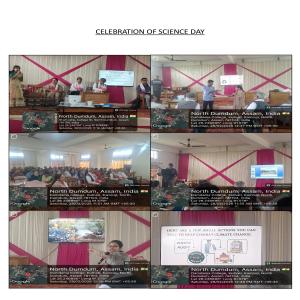
February 28, 2026, the Internal Quality Assurance Cell (IQAC) of Damdama
College, in collaboration with the Ellora Science Forum, hosted an awareness
program focused on Solid Waste Management and Disposal in observance of World
Science Day. The event commenced with an inaugural address by Dr. Saranjan
Sarma, Principal of Damdama College, who emphasized the importance of Science
Day and its role in fostering advancements and societal benefits derived from
scientific inquiry. Dr. Sarma also articulated this year's theme, "Women
in Science: Peace and Development to History." This title emphasizes the
significant roles that women in science have played throughout history,
highlighting their contributions to achieving peace and fostering development
across various fields. From groundbreaking research to innovative solutions, women
scientists have not only advanced knowledge but also actively participated in
shaping a more equitable and peaceful society. Their achievements are integral
to our understanding of historical progress and the continuous pursuit of a
better world. This exploration showcases the intersection of gender, science,
and societal advancement, celebrating the vital impact of women in these
crucial areas.
During
the program, Mr. Rajiv Mahanta provided a compelling overview of the historical
context and contributions of the founders of Damdama College. Dr. Manoranjan
Sarma, in his welcome address, highlighted the establishment of the Ellora
Science Forum, recognizing Mrs. Ellora Rai Choudhury for her scientific ethos
and her remarkable decision to donate her body posthumously to the Guwahati
Medical College for research purposes. This act has inspired over 500
individuals to commit to body donation, reinforcing a scientific approach to
life and death. Dr. Sarma underscored the need to confront superstitions and
social stigmas—issues the Ellora Science Forum aims to address—by fostering
critical thinking and dismantling cultural practices that contribute to social
maladies such as witch hunting and female infanticide.
The
subsequent speaker, Dr. Dipen Sarma, focused on the critical issue of solid
waste management in rural areas. He emphasized the necessity of segregating
waste into dry and wet categories to mitigate environmental impact. Wet waste,
he recommended, should be composted, while dry waste—including plastics and
construction debris—should be directed to the Guwahati Municipal Corporation
(GMC) for proper recycling and disposal, rather than incineration. Dr. Sarma
advocated for a holistic approach to maintaining a clean and green environment
through effective solid waste management practices.
Dr.
Bipasha Sarma, a renowned ophthalmologist and the founder of Sankalpa: A Green
Alternate, an NGO dedicated to environmental conservation, recently delivered
an engaging and thought-provoking talk titled “The Impact of Garbage on Climate
Change.” During her presentation, she fostered an interactive atmosphere,
encouraging participants to think critically about the relationship between
waste management and our planet's climate.
Dr.
Sarma outlined several actionable steps and initiatives aimed at combating
climate change, emphasizing the importance of conducting Waste Audits to assess
and understand waste generation. She stressed the significance of proper waste
segregation, as well as the powerful mantra of "Reduce, Reuse, and
Recycle." To equip attendees with practical knowledge, she taught and
demonstrated the art of composting, showcasing how this process can transform
organic waste into valuable fertilizer while minimizing landfill contributions.
Additionally,
Dr. Sarma introduced the concept of the resin identification code, a critical
tool for understanding and categorizing plastic materials, which can help
individuals make more informed choices regarding recycling and waste reduction.
Her session inspired participants to take proactive steps in their own lives to
contribute to environmental sustainability.
The
subsequent speaker, Najib Ahmed, presented a lecture entitled “Climate Change
Effects: Heatwave, Flood, River Erosion, Drought, and Other Disasters in
Assam.” He elaborated on heatwaves as a consequence of climate change,
highlighting their association with prolonged shifts in temperature and weather
patterns. The rise in temperature has had significant repercussions in Assam, a
region characterized by a tropical, warm, and humid climate that is
particularly vulnerable to the impacts of climate change.
He
noted the occurrence of a heatwave hazard in September 2024, during which media
reports indicated that 11 fatalities were recorded due to heatstroke.
Additionally, there were 14 recorded deaths in May and June 2025, with mercury
levels exceeding 39.6 degrees Celsius and humidity levels reaching 75%. This
resulted in a human perception of heat equivalent to approximately 60 degrees
Celsius. The National Disaster Management Authority (NDMA) has officially
recognized heatwaves as a major disaster, underscoring the urgency of
addressing this critical issue.
Back to Events