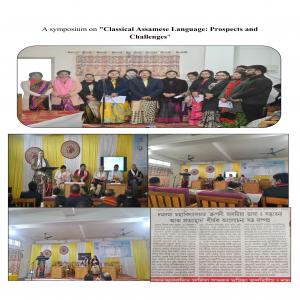
A
symposium titled "Classical Assamese Language: Prospects and Challenges"
was convened by the Sahitya Akademi in collaboration with Damdama College on
December 30, 2025. This event aimed to delve into the rich heritage of the
Assamese language, which has been officially recognized as a classical language
by the Government of India, while also addressing the myriad challenges it
confronts in contemporary society.The symposium was graced by the presence of
Diganta Biswa Sarma, Convenor of the Assamese Advisory Board at the Sahitya
Akademi, who served as the Chief Guest. The proceedings were adeptly chaired by
Dr. Suranjan Sarma, Principal of Damdama College, facilitating a robust and
constructive dialogue among the participants. Dr. Sarma highlighted the importance
of the Assamese language being officially recognized as a classical language by
the Government of India. This prestigious status has been conferred to only a
select group of languages—currently, just ten, including Tamil, Telugu, and
Marathi. The inclusion of Assamese in this elite category is not only a matter
of pride but also a significant privilege for the people of Assam. He also
emphasised that this recognition underscores Assam's rich linguistic heritage
and cultural identity. He argued that more efforts must be made to promote and
develop the Assamese language further, ensuring it receives the attention and
resources it deserves to flourish in today's globalised world. This, he
asserted, is vital for preserving the language for future generations and
enhancing its presence in literature, education, and public life.
In his
welcome address, Regional Secretary of Sahitya Akademi, Davendra Kumar Debash,
provided an overview of the Academy, highlighting its diverse award categories
and language divisions. He noted that the Academy has conferred approximately
5,000 publications and 700 awards, including the prestigious Bal Sahitya Award.
Emphasizing the pivotal role of youth in nation-building through literature, he
articulated the Academy's primary objective: to foster and promote high-quality
literary work. To engage the younger demographic, a Youth Award has been
instituted, alongside organized literary programs in universities and colleges.
The chief
guest of the Symposium Diganta Biswa Sarma’s introductory remarks underscored
the necessity of familiarizing audiences with classical languages, noting that
ten languages have been accorded this status in India, including Pali. He
referenced Maharishi Aurobindo’s framework categorizing the evolution of Indian
languages into five distinct eras
1. Vedic/Kāvya Era
2. Mahākāvya Era
3. Sanskrit Classical
Language Period
4. Neo-Vaishnavite Age
5. Post-Vaishnavite
Classical Language Period
Sarma further
elucidated on the functional dimensions of classical languages, encompassing:
- Vedanta Darshana
- Bhakti Darshana
- Rasa Tatta Darshana
Diganta Biswa Sarma
concluded by emphasising the unique attributes of classical and modern Indian
languages, establishing their significant role in India’s cultural tapestry.
Former
President of Sahitya Akademi, Kuladhar Saikia, elaborated on the trajectory
that led to the Assam language receiving classical language status. He
disclosed that a comprehensive 342-page report was submitted to the Ministry of
Culture by a committee led by him. This report was subsequently reviewed by
linguistic experts and included a formal correspondence directed to the Home
Minister. The findings highlighted the intrinsic connection between culture and
language, demonstrating the profound, traditional roots of the Assamese
language. Despite the absence of preserved Assamese manuscripts carved in
stone, Saikia asserted a greater obligation to transcend mere recognition of
classical status, calling for proactive measures to develop and preserve the Assamese
language.
· His first reaction regarding Tamil as a classical language was mentioned in the context of classical language.
·
He
said that people should be appointed in the field of classical language based
on the ancient culture, antiquity, and qualities of the language and script.
The next speaker was renowned Assamese author
Pradip Jyoty Mahanta, who delivered the keynote address highlighting the rich
historical context of the Assamese language, supported by fifth-century
inscriptions. Sarma articulated that the language has evolved into a
politically sensitive issue, closely intertwined with ethnic identity. He
posited that the future of the Assamese language will be marked by enrichment
through the incorporation of elements from other languages. Additionally, he
emphasized the importance of maintaining linguistic heritage during turbulent
times, advocating against the trend of sending children to English medium
schools. Instead, he called for educational institutions to prioritize the use
of the Assamese language in their curricula.
Back to Events